

Contents
01. What we are
02. What we’re not
03. Why we exist
04. Who we’re for
05. Our values
06. Our core team
07. Our funding
What we are
RadHR is a community where groups and organisations can share their radical internal policies. We make visible the learning and collective processes that shaped those policies. Together, we’re exploring anti-oppressive, caring and equitable ways of organising.
RadHR includes:
- A library of policies and processes, created, adapted and shared by groups and organisations from across the RadHR Community.
- A community forum where people doing this kind of work can discuss ideas, make requests and figure out thorny internal issues together.
- A series of events where people doing this work can come together and share learning, frustrations, wins, challenges and solidarity.
- A blog of updates from the core team and stories from the community describing experiences of practicing different ways of working together.
- A set of guides to support groups creating their own anti-oppressive versions of a range of common policies, while highlighting the relevant UK legal issues that can come up in those policies.
- Finally, there is a core team who administer the website and forum and coordinate or facilitate the majority of the activities above, including leading on the strategic direction of the organisation.
The core team are also directors of RadHR Ltd, a non-profit Company Limited by Guarantee (reg’d 13949867). You can read more about the structure in our FAQs.
What we’re not
Contrary to some common beliefs, RadHR is not:
- The expert on all things radical and HR related
The vast majority of the RadHR community are not HR professionals. We are people who have been in a range of groups and collectives and tried to think about how to organise ourselves effectively, in ways which align with our values. - A consultancy that will write your radical policies for you
The core team’s work is about supporting the community to share learning and support one another to create more radical policies and ways of working together. In limited situations, the we might be able to help you facilitate some parts of your own collective policy making process, but we don’t write policies for other organisations. - The authors of all the amazing policies in the library
Some of the individual policies are from RadHR, as an organisation, but the vast majority are from others in the community who want to make their own wisdom and learning available to others. More than forty different community groups, activist collectives, workers co-ops and smaller non-profit organisations have contributed to the RadHR policy library, bringing an incredible breadth and depth of insight and knowledge to the community.
Why we exist
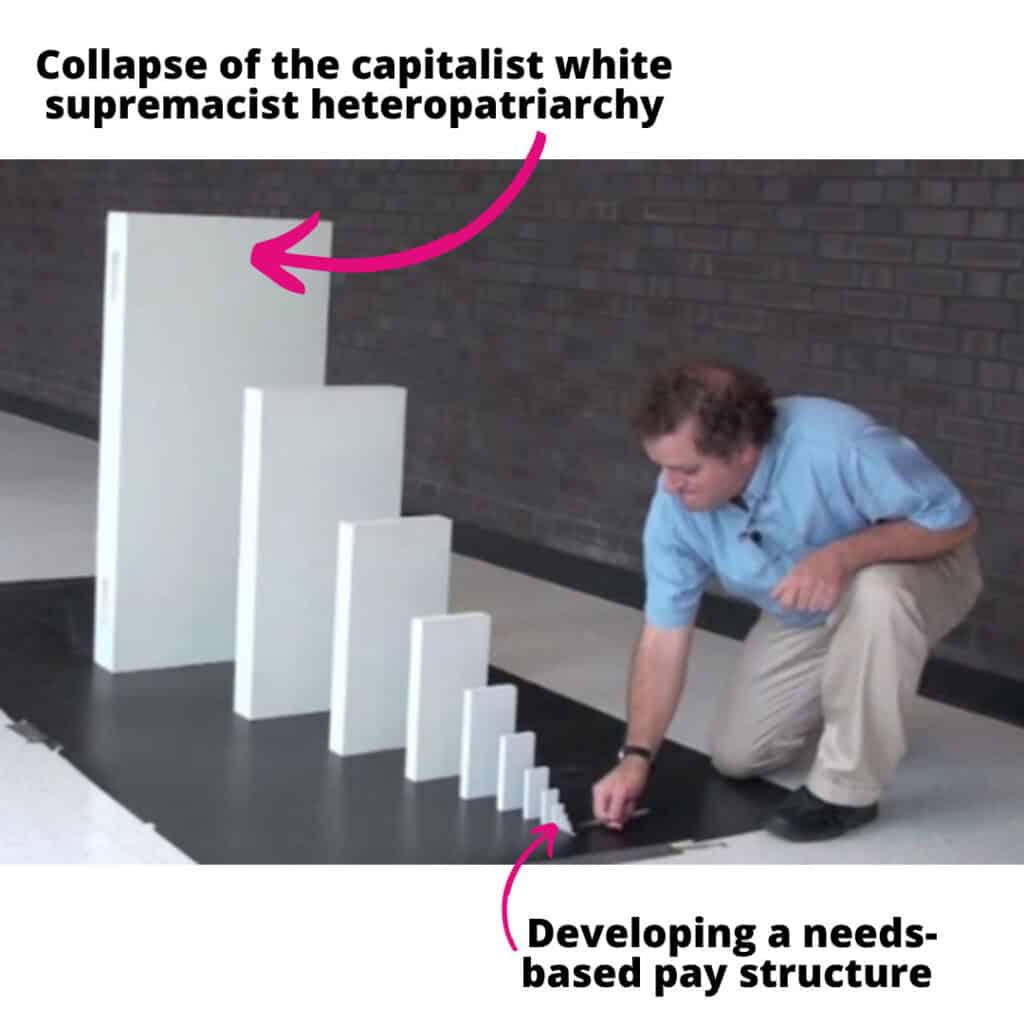
RadHR emerged from a belief that if our community groups, non-profit organisations and social movements are going to be successful in overthrowing the systems of power that create so much harm in society, that we must find ways of challenging and creating alternatives to the ways those systems play out in our own contexts.
In the conversations that led to RadHR, the core team heard about:
- Frontline youth and homelessness charities whose ‘Acas-approved’ disciplinary and accountability processes replicated the punitive systems that they oppose;
- Community-based migrant support groups who found that standard voluntary sector safeguarding procedures put their members at increased risk of deportation, or having their children take away;
- Activist groups and campaigning organisations whose recruitment and decision-making processes excluded people from less-privileged backgrounds;
- Workers’ coops, committed to valuing people equally, whose pay structures reinforced wider hierarchies of what and whose work is valuable;
- Solidarity networks that—due to the urgency of the work and funders’ demands—end up replicating standard 9-5 working structures, which don’t suit members’ needs or acknowledge people’s different capacities.
In other words, the ways we organise our work are often reinforcing the systems and values we wish to change or abolish. Many of us have tried to write some of our own value-driven policies and processes, but it takes a lot of time and it’s too big a job for any one group alone. RadHR is part of figuring out alternatives together.
Rather than seeing radical internal policy making as a distraction from, or insignificant to the wider work of changing the world, it is a fundamental starting point: if we can’t do it here, what makes us think we can do it elsewhere?
There are too many examples of groups that are doing critical social justice work in the wider world that get torn apart by the pain and harm of unchecked internal power dynamics, unhealthy conflict and basic lack of care. The costs of not paying attention to this work are painfully real for anyone who has been up close to them, even if they are not always visible to those in the wider world.
RadHR is a small part of a complex puzzle; the core team hopes that by enabling more sharing and learning around value-led internal policies and processes, that all of our groups’ wider work will be stronger and more sustainable, and that our social movements will become more powerful and effective in the process.
Join the RadHR Community to join others transforming the ways we organise!
Who we’re for
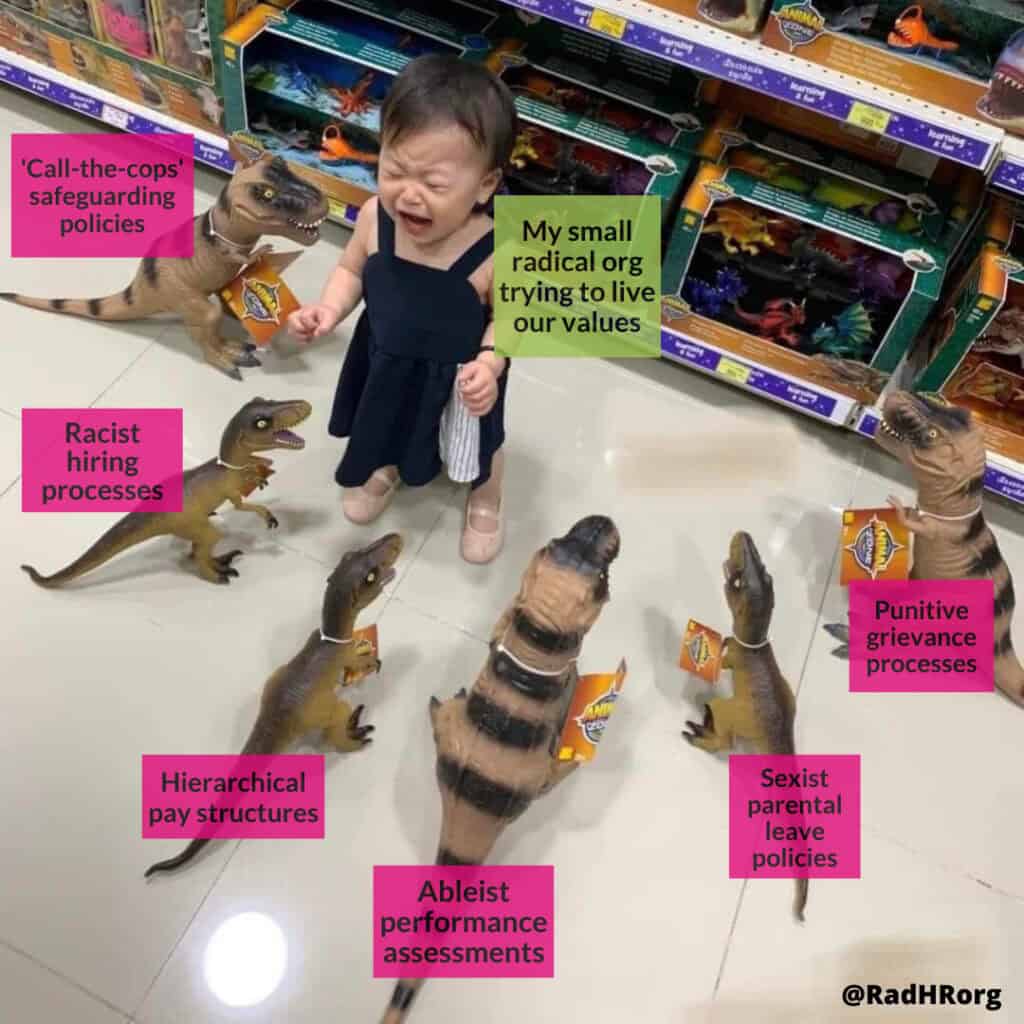
RadHR supports people and groups organising for social change to share radical or progressive internal policies and processes. It is an ongoing collaboration between people figuring out how to organise ourselves according to our values.
If that sounds like you, welcome!
RadHR began from the perspective that none of us are ‘experts’ at the work of living our values—the answers need to come from all of us.
RadHR is a community for a range of groups, including:
- Grassroots mutual aid and community groups
- Small NGOs and voluntary sector organisations
- Campaigning organisations
- Workers’ coops
- Trade unions
- Renters unions
- Activist collectives
- Arts organisations
By building on each others’ experiences, learning and understanding, we can figure out together what it means to live our values in how we organise ourselves!
Our values
These are the values the core team works by, and tries to build the community from:
Anti-Oppressive
The world is already full of oppression. Our ways of organising—our policies, processes and practices—should be actively counteracting the white supremacy, patriarchy, classism, ableism, homophobia and transphobia experienced by many people in the wider world. As should the ways we engage with each other as a community across this site.
Open
To collaborate, we need to be able to share what we’ve got and what we’ve learned with others walking similar paths. There can be a vulnerability in sharing our learnings, especially when we’re not 100% sure of ourselves (which we never can be with this kind of work)! RadHR aims to create spaces where we can build the trust needed to share effectively with one another.
Collaborative
The question of how to really live our values is far too big for any of us to answer on our own! We need each other if we are going to figure out alternatives to the kinds of oppression that have dominated management, HR, and organisational thinking for so long.
Messy
Organising in ways that radically shift existing power structures and oppressions is never going to be neat and tidy. Or comfortable. If it is, we’re probably not changing that much. So instead of trying to avoid discomfort, uncertainty and untidiness, let’s embrace the mess!
Radical
The Black feminist activist and writer, Angela Davis, says: “Radical simply means ‘grasping things at the root.’” If we’re challenging oppression and practicing values around care and collective power, we need to get beyond the symptoms of social problems. This can force us to face the ways these problems show up in ourselves, our communities and organisations, as well as wider society. To live our values, we need to push for change on all these levels, even—and especially—when doing so pits us against dominant power structures, or forces us to challenge our own positions.
Our core team
RadHR was started by Kiran, Liam and Rich in late 2021. Kiran has since moved on to People Support Co-op and Veronica joined in late 2023. There are now three of us in the core team, working with a range of partner organisations and a freelance facilitators pool.
Below is a bit more info about why the Core Team are so keen on this work…

Liam Barrington-Bush
Partnerships & Communications
I have spent the last two decades awkwardly moving between grassroots activist groups (Wretched of the Earth), professional NGOs (Greenpeace, People & Planet, London Mining Network), and frontline community organising spaces (Sweets Way Resists, London Renters Union). In each of them I found groups struggling to find ways of working together that aligned with their values and allowed a range of people to engage with them across power and privilege lines. In 2013 I wrote a book about these struggles called Anarchists in the Boardroom.
The struggles were varied though, between these spaces; the NGOs had modelled themselves after corporations; the activist groups had usually refused most forms of structure, leaving power in the hands of the most privileged; the community groups had typically found that the models available excluded most of their members from being actively involved.
But there were folks in each of these spaces trying to address the same issues, from different perspectives. I found myself becoming an informal repository of some of the early radical organisational policies that now fill the website, sharing them back and forth between groups and across sectors, based on personal contacts and connections. Chats with Kiran and Rich helped turn this informal practice into a (hopefully!) far-more-accessible project with wider reach!

Veronica Deutsch
Research, Guides & Blogs
I am interested in how we can build movements that are more inclusive of migrant and feminised workforces. I first came to RadHR in 2023 as a former coordinator with the Nanny Solidarity Network (NSN)—a grassroots mutual aid organisation that provides support, emergency aid, and space for collective action to nannies & au pairs in the UK. As part of this work, I helped to establish the Childcare Workers’ Solidarity Fund, the Post Pandemic Childcare coalition, and the Independent Workers of Great Britain’s Nannies & Au pairs branch—the first trade union branch for nannies & au pairs in the UK.
I came to organising as a worker looking to build community but, having only ever worked as a nanny, I had zero experience of how to run an organisation. In its early stages, the NSN was keen to organise in ways that prioritised care and avoided traditional, top-down ways of working, but had little idea of where to start—resultantly, its organisers relied heavily on the generosity of like-minded groups which offered to share their policies and processes as ‘templates’. From this, I quickly realised the power of sharing our ‘ways of working’ with one another.
I am currently completing a PhD at the University of Bristol exploring how nannies & au pairs in London build community with one another, and the different factors that shape their efforts to build collective power.

Richard Hawkins
Design & Tech
I love organising and tinkering with systems, documents and websites; getting excited about colours and typefaces; and working with groups to create policies and processes that work well for everyone.
I’m a designer and activist from Bristol/Somerset now living in Edinburgh. I worked at PIRC for 15 years through various organisational arrangements, including a flat self-managed structure for 7+ years. I’ve also been involved in several housing coops, helping start one in Machynlleth, and supporting others, especially with policy development and finance.
For many years I’ve wanted to help build a library of more radical, democratic and liberatory organisational policies and practices, so this is great! I spend a lot of time thinking about how to do finance work in a more transparent, engaging and democratic way: it’s an area where so much power is hoarded within organisations, especially by white middle class men, and that needs to change!
Current Core Team Aims
The RadHR Core Team sees our role as facilitating the sharing of knowledge and experience across the community. We are a small team—and it’s easy to find ourselves pulled in too many directions!—but these are the current priorities we have set ourselves for 2025/2026, in facilitating the RadHR Community, maintaining the website and working to uphold the values above:
- Building understanding. Showing how ‘default’ organisational practices, including legalistic approaches, often perpetuate wider systems of power/harm/violence.
- Broadening who’s involved. Recentring around groups in different contexts that experience, and challenge, a range of forms of structural oppression.
- Staying radical. Pushing the limits of what is considered ‘acceptable’ in the worlds of HR and operations, from an anti-oppressive perspective.
- Advocating collective approaches. Encouraging groups to think about and practice ‘HR’ more collectively, decentring experts, professionals and managers.
- Practicing what we preach. Regularly reflecting on how these aims inform our own ways of working, including how we approach our policies, structures, working culture, etc.
Our funding
Our funding in 2026 comes from:


We make a small amount of trading income from workshops and consultancy. We have previously received funding from Disrupt Foundation, Lankelly Chase Foundation and Thirty Percy. Our expenditure in 2025 was ~£120k, around 80% of which was used to pay workers.