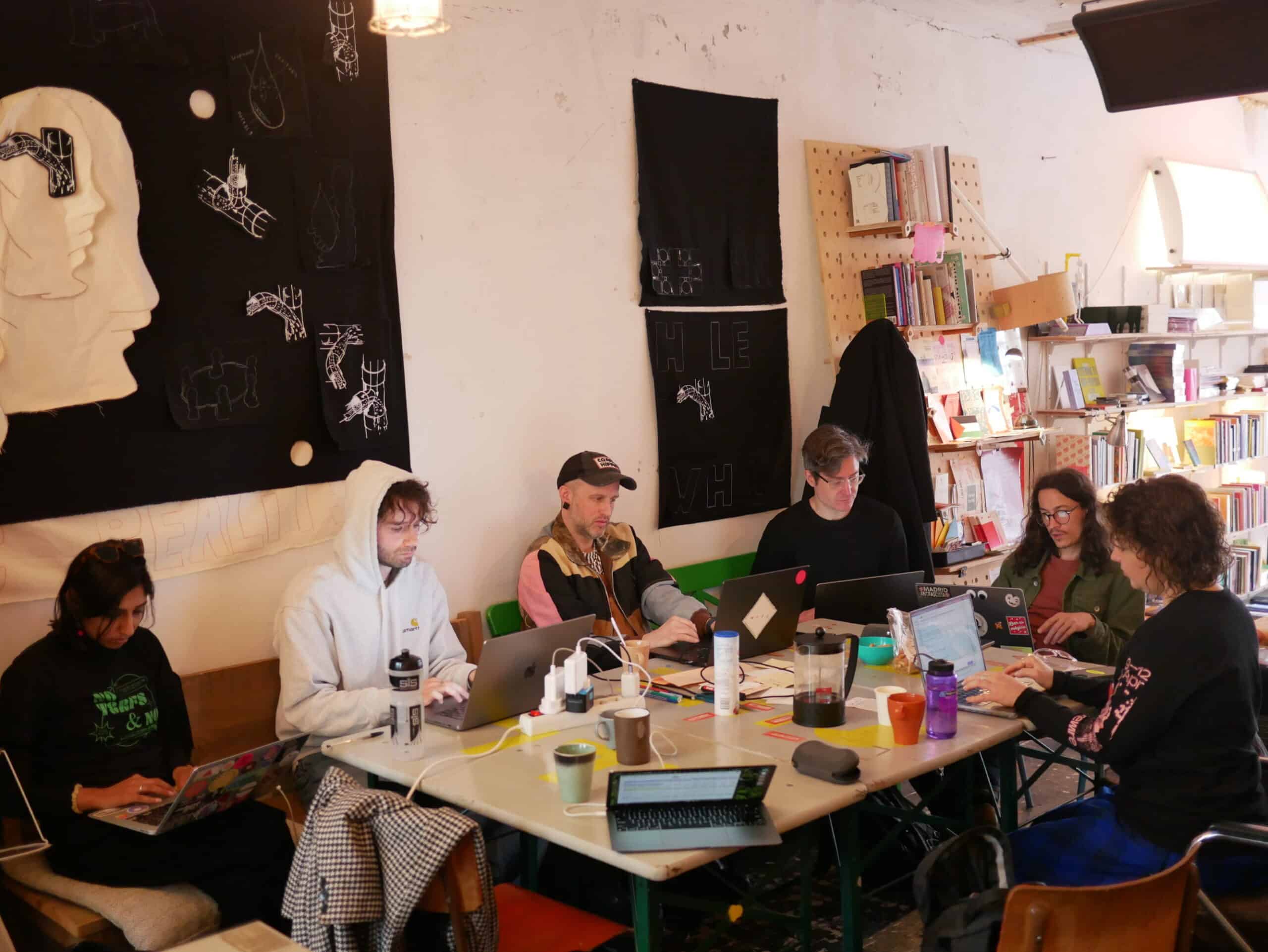
Common Knowledge is a not-for-profit worker owned cooperative of technologists, designers, researchers and facilitators. We work with grassroots organisers and communities around the world to build power and achieve radical change. Our day-to-day includes work on projects ranging from digital infrastructure, identity design and website design and development, to delivering digital security training and organising an annual festival on politics and visual culture. In addition to this project-based work, there are a number of internal areas of responsibility that keep the cooperative healthy, cohesive and sustainable. These include Governance, Finance, New Work, and Communications. The stewardship of these roles typically rotates between members every six months, which means that the clarity of documentation of associated policies and processes is very important for continuity, more so than in the average workplace.
The number of the cooperative’s members has fluctuated since we formed in 2018. We started as three freelance members, who were able to make the leap to employees in 2021. Today, we have five members who are employees in the UK and two based overseas as freelancers. In addition to full members, we have freelancers who work with us on a regular basis, or help with specific projects. The composition of the cooperative and its wider ecosystem of collaborators is important to consider when developing policies. Some questions that arise include:
- Does the policy apply to all members or all employees?
- Does it apply to UK based employees only?
- How do we make the workplace as equitable as possible for different types of workers, while maintaining financial sustainability?
How we develop policies
As is often the case in small organisations or start-ups, Common Knowledge’s first policies were created on an ad hoc basis. It’s rare to have a role dedicated to governance in workplaces of this scale, and the task can easily slip to the bottom of the to-do list of a myriad more pressing issues — like meeting the deadline for a grant application, or finishing a project so everyone can get paid at the end of the month. Our commitment to shaping policies around our political and ethical principles meant that many off-the-shelf templates out there rarely met our needs. We’ve really appreciated RadHR’s Policy Library as a valuable resource for this reason.
Since we’ve been around for a few years now (our eighth birthday is coming up in October!), most of our core policies have been revised since their inception. Though some policies may simply adhere to legal requirements and not be particularly radical, we see our process of policy development as, in itself, radical, because it is totally democratic, which contrasts vastly with other organisations, even within the “third sector”. We’ve been guided by sociocracy as a governance system since the very start. Sociocracy is well-suited to nonhierarchical teams, with one of its key features being decision-making based on consent, rather than consensus. At its core, the question asked when facing a decision is not “Do I agree to this?” but “Do I object to this?” The tweak in perspective helps speed up decision making.
Sociocracy’s proposal based decision-making process is used when amending or creating new policies. Any coop member can make a proposal, which others respond to in rounds of clarifying questions, reactions, and consent. This can happen in our monthly Governance meetings, but is normally done via Twist. We recommend Twist as a communication tool for async collaboration that doesn’t create the sense of urgency of Slack’s notification blasts. Using Twist gives everyone time to think about their response and reduces the number of meetings in our members’ varied schedules. Whoever makes the proposal gives a reasonable timeframe to give everyone the chance to respond, which defaults to seven days if there is none set. If nobody objects, the policy is passed. Non-members are also asked to input on any policies that impact them, or give an indicative position, though the ultimate responsibility for defining and implementing the policy rests with members.
There are challenges to this process, such as the patience needed when sticking to sociocratic practices around decision making, and having enough people give input when project work feels pressing (pretty much always!). But we believe the benefits of democratic decision making far outweigh any frustrations.
Policy drift
In more traditionally structured, hierarchical organisations policies are developed and decided upon by a small group of senior staff, the board, or an external HR consultant. Even if the workforce is unionised and the reps have some input to steer policies towards prioritising workers’ needs, the ultimate decision sits with a powerful few. Regular workers typically have little agency to instigate policy changes. Here, policy drift can happen more frequently. Policies may have an annual renewal date, but there may be nothing to prompt their review beyond compliance with changes in law. If a staff consultation does exist, this can be lengthy and involve multiple levels of approval.
At Common Knowledge, though the process of updating policies is more democratic and agile, the headspace needed to review and improve policies can be hard to prioritise alongside project-based work. Once a decision on a policy has been made, the act of documenting it in our handbook can have a lag, causing a discrepancy between what’s been agreed and what is practiced day-to-day. This can lead to confusion and misalignment between coop members. For example, an update on the annual leave policy was agreed on on Twist, but not updated in the handbook or the HR platform immediately after, which periodically caused debates about the allowance. The risk is compounded by the fact that the Governance area of responsibility rotates between members every six months, so details can slip in the handover from one person to the next. On the other hand, it also means there’s fresh energy injected into the role twice a year. This is much needed, since experience of the tenure can vary. It can be quiet, dominated by routine tasks, which often get swamped by project work. Or a major stressful challenge might emerge – for example, a grievance, an off-boarding or a disciplinary process. These sometimes steal time from project or more systematic work. We’ve instated the role of Operations, which always sits with the same coop member and helps provide some regular support and consistency to role rotation.
The challenges of resource limitations
For Common Knowledge, consultancy work income tends to be short-term — two to six months per project. Each of these contributes only in part to covering monthly costs of running the organisation. Grant-based income tends to be longer term, but grants lasting more than three years are rare and core funding is notoriously difficult to come by. This is perhaps the biggest challenge to making policies that are radical in substance, not just the process by which they are developed (though the importance of this is not to be underestimated!). Generous paid parental leave, sick leave, carers’ leave and annual leave are all big contributors to the psychological and physical wellbeing of workers, but they come with considerable financial investment and risk. If we lose funding or other income one financial year, the potential result of being forced to cut back benefits would be a bitter move backwards. Policies that provide a radical level of support and care to workers rely on sustainable income. This is a consideration we’d urge to be on the agenda of funders who are committed to making meaningful change in the wellbeing of wider society. You get the policies you pay for. However, because we are very transparent (even to non-members) about financial information (especially when times get hard), everyone can come to understand the realism of particular policies and how they might destabilise the organisation. If difficult decisions have to be made what is important is that they are made collectively. Everyone has “skin in the game” in making sure the co-op continues to exist, we all remain in our jobs, and most crucially can continue its mission.
Making our Handbook public
The decision to make our Handbook public was one we made early on, inspired by examples from within more orthodox capitalist startups, such as Basecamp, Gitlab and Airbyte and more radical ventures like Enspiral. It first lived in Notion, but has since (mostly) been migrated to GitHub and published via HonKit, a fork of GitBook that we used because this is how some peers (like the aforementioned Enspiral) manage their handbooks. We decided to move away from proprietary platforms for hosting the handbook in line with our commitment to open source principles. One may glean from our coop’s name that sharing learnings generously with others is extremely important to us. We want to encourage other organisations to experiment with non-hierarchical governance models. The more open we are about our processes, the more opportunity we have to transform the relational fabric of work life on a wider scale. Publishing our Handbook, which includes policies as well as process documentation makes us open to both public scrutiny and input, and we’ve had feedback on others utilising it as a resource. We know people value it because they occasionally tell us they have read it, which is very affirming. These little moments of appreciation help keep us going in updating it, so if you have used it and find it useful, or think there is something missing you’d like to learn, do reach out!
Making policies radical: A summary
- Involve as many people as possible in the development of policies – diverse perspectives strengthen the policy. And then everyone has a greater stake in sticking to what you’ve agreed on in the day-to-day
- Schedule in regular policy reviews to avoid policy drift
- Have a clear process for proposing, discussing, and committing to changes
- If financial resources are limited and you can’t offer as generous a policy as you’d like, focus on one or two that would have the impact on most workers.
- Make the rest into a wishlist to work towards when resources allow.
You can get in touch with Common Knowledge via the following platforms:
Contact email: hello@commonknowledge.coop
Instagram: https://www.instagram.com/commonknowledge.coop/ (most active)
Bluesky: https://bsky.app/profile/commonknowledge.coop
Mastodon: https://social.coop/@commonknowledge